
Lumbar spinal stenosis
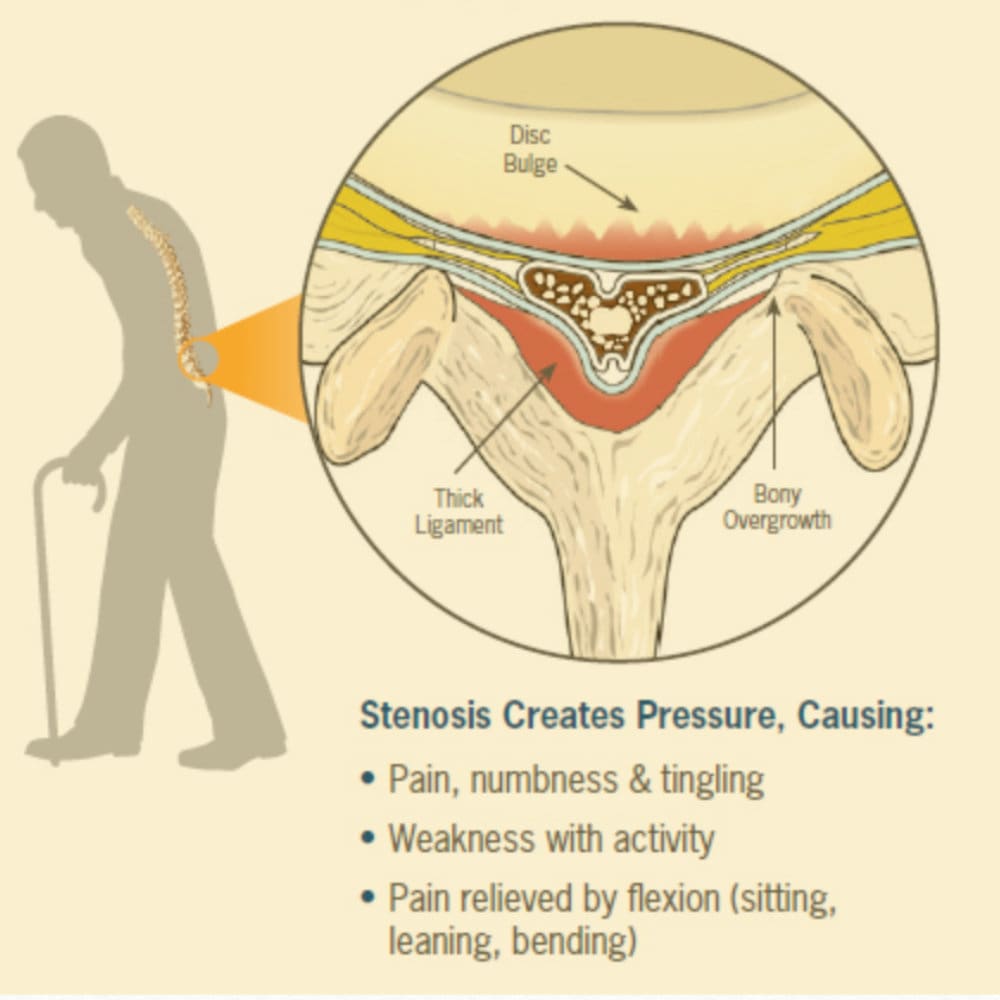
To understand lumbar spinal stenosis, we should start with the symptoms: back, buttock and leg(s) pain, numbness and weakness with standing and walking.
If you ever wonder why you cannot walk as far as you used to without pain and heaviness/weakness in the legs, it’s probably LSS.
If you wonder why you’re leaning on your grocery store cart, it’s probably LSS.
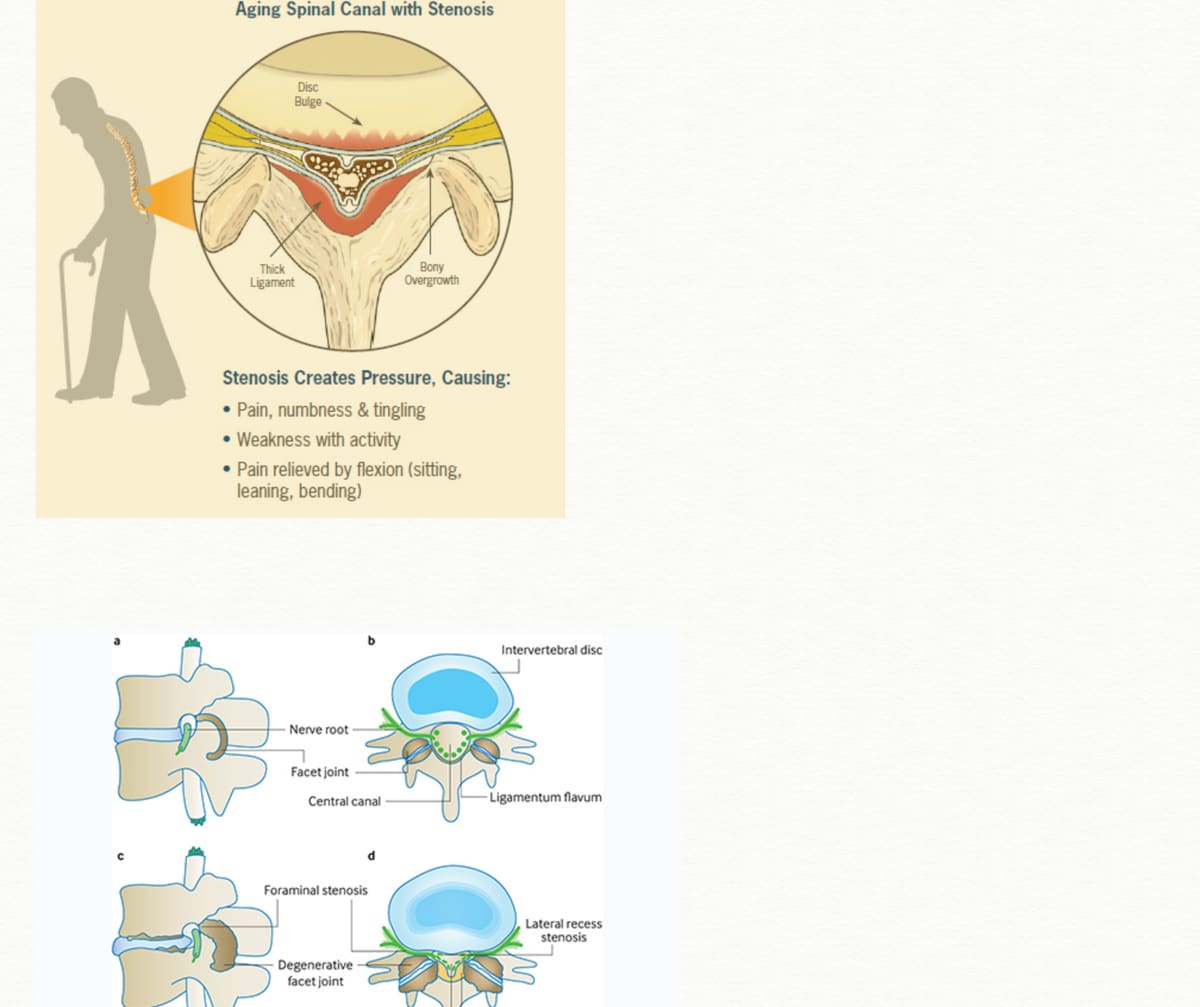
Why does sitting, bending forward, or bringing your knees to your chest relieve your pain? Yes, you guessed it, it’s probably LSS.
In a couple of paragraphs, we will explore two new treatments for LSS, but first let’s look at a picture of a lumbar segment and what causes LSS.
From the front, disc bulges (technically called a protrusion) can put pressure on the spinal canal containing the spinal nerves from front to back.
The back of the canal is formed by a strong ligament (ligamentum flavum), the bones of the back of the vertebrae called laminae, and the two mobile joints called facet joints.
When these three structures degenerate, the spine becomes naturally more unstable. In order to stabilize itself, the ligamentum flavum becomes thicker, and the laminae and facet joints become bigger. These changes put pressure on the spinal canal from back to front.
So the canal narrows, the nerves become crowded, and you start leaning forward to get some relief in standing and walking.
Traditionally, treatments for LSS have started with physical therapy and exercise to build stamina and endurance, to epidural injections with steroid (which decrease the inflammation and pain around the compressed nerves in the canal), to surgical decompression, which involves removal of the aforementioned laminae and sometimes part of the facet joints and sometimes even part of the discs.
Although years in the making, two new techniques have gained Medicare approval. Mild and Vertiflex. They are both minimally invasive outpatient procedures done in an Ambulatory Surgery Center.
The Mild procedure removes part of the ligamentum flavum with the aim of decompressing the lumbar central canal and giving the nerves some breathing room.
The Vertiflex procedure places a small titanium implant in the back of the spine, between the spinous processes, in order to limit canal narrowing when the spine leans backward (extends). It is similar to a doorstop.
The small Vertiflex implant can be easily removed. Neither of these two procedures limits any potential later surgical procedure or any other treatment.
These are just two of a series of new interventional spine procedure that have gained insurance approval in the last year or so. This is an exciting time for our field, as we can offer hope and pain relief to growing number of patients.
Out staff is happy to discuss these or any other treatments for your lumbar and leg pain.