
Shoulders are complex
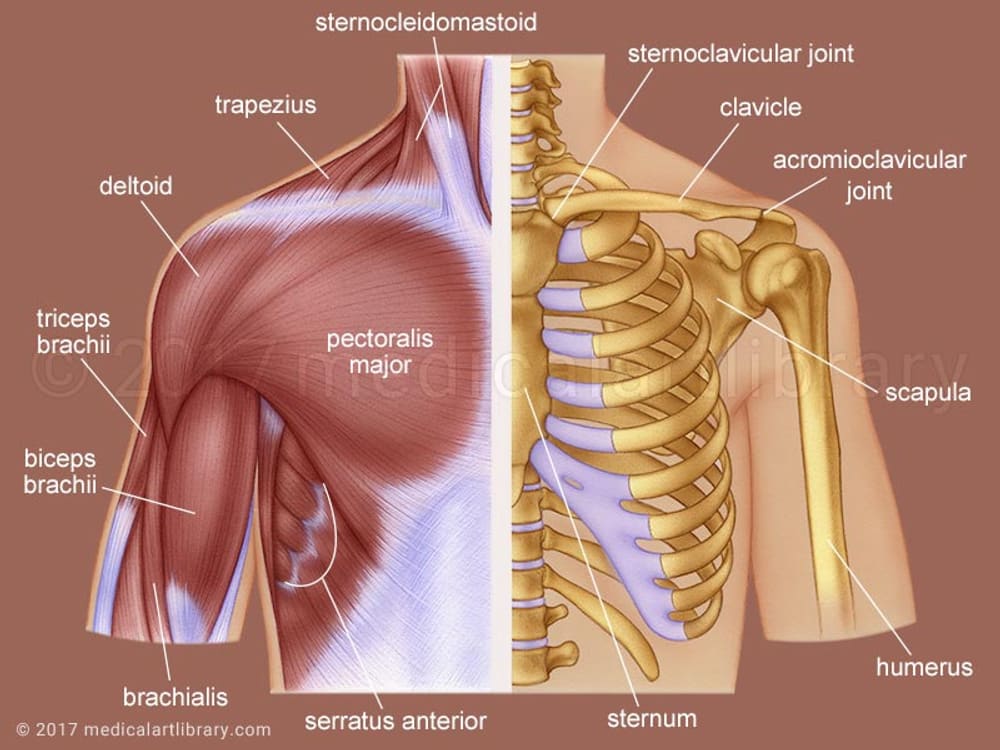
Shoulder pain is a common complaint that we at Precision Regenerative and Functional Medicine see, diagnose, and treat. Oftentimes, patients complain of pain with reaching overhead, shoulder pain at night, or decreased range of motion of the shoulder. Before discussing possible causes and treatments of shoulder pain, we will briefly discuss the anatomy of the shoulder.
Shoulder anatomy
The shoulder is one of the most remarkable joints in our body and allowed our ancestors to stand and use their forelegs (arms) for purposes other than ambulation. Our mobile shoulders allow us to climb and reach for things overhead, carry objects while walking, and throw objects. Our shoulder is able to move in three separate planes and up to 180 degrees in abduction (away from the body), 180 degrees of forward flexion, 60 degrees of extension, and 90 degrees of internal and external rotation. With the amazing range of motion afforded by the shoulders, there is a potential price to pay: a lack of stability.
The deepest anatomical layer of the shoulder are the bones. The humerus, or long bone of the arm meets the acromion, a socket located on the scapula, to form the glenohumeral (GH) joint. The clavicle meets the acromion (another part of the scapula) to form the acromioclavicular (AC) joint. At the other end, the clavicle meets the sternum to form the sternoclavicular joint. Movement of our shoulder “joint” actually occurs in these three joints and between the scapula and the ribs in the back.
More superficial to the bones, the second anatomical layer are the ligaments and tendons. The labrum (“lip” in Latin) is a thick cartilage that secures the humerus into the glenoid. The humerus is further secured into the glenoid and also moved by the tendons of the four rotator cuff muscles (supraspinatus, infraspinatus, subscapularis and teres minor). There are numerous other ligaments around the AC joint and other shoulder structures, with the main function of stabilizing the three joints.
The most superficial layer are the overlying muscles (trapezius, pectoralis major/minor, biceps, and deltoid), which further stabilize and move the shoulder and arm.
Common shoulder problems
Shoulder osteoarthritis
The main shoulder joint, the glenohumeral joint, is a shallow joint and wear and tear over time can lead to cartilage loss and osteophyte (bone spur) formation. The loss of cushioning between bones leads to pain. This is often described as a deep, aching-type pain “inside” the shoulder.
Rotator cuff tear
Any one of the rotator cuff tendons may tear, but most commonly it is the supraspinatus that tears from overuse and poor shoulder biomechanics. A partial tear may result in minimal weakness and a complete tear may have more pronounced weakness of the shoulder in certain movements/positions.
AC joint
The acromioclavicular (AC) joint is a small joint located at the junction of your clavicle (collar bone) and scapula, approximately where your seatbelt goes over your shoulder. This joint can become arthritic over time, or may be injured acutely after a traumatic impact or fall.
Adhesive capsulitis
Adhesive capsulitis also known as “frozen shoulder” occurs when the shoulder capsule contracts and sticks to the bone, resulting in severely reduced range of motion. This is a common complication after prolonged shoulder immobility (due to injury/trauma or surgery) and more common in diabetic sufferers.
Shoulder impingement
Poor biomechanics may lead to inflammation of the subdeltoid or subacromial bursae (fluid filled sacs), a condition known as bursitis. When these bursae become inflamed and swollen, the movement of the shoulder can be impaired. Pain is typically worse when moving the arm above your head, and people who sleep in this position notice increased pain at night.
Referred cervical pain
The nerves that run down your arms originate in your neck. When one of these nerves is compressed or irritated, it may cause pain running down the arm known as a radiculopathy. The cervical facet joints can often mimic shoulder pain and refer pain to the shoulder girdle and periscapular region.
Treatment options
Once you have been properly evaluated and diagnosed (including but not limited to a thorough history, physical examination, imaging review, and diagnostic injections), there are several non-surgical options that remain:
Platelet-rich plasma
Platelet-rich plasma (or “PRP” for short) is a solution of your own body’s concentrated growth factors that we obtain from drawing your blood. We utilize our in-house centrifuge to spin down and separate your blood cells from the platelets and growth factors. We can then inject this healing fluid into the damaged areas of your shoulder using image guidance to precisely guide our treatment.
Bone marrow-derived regenerative cells
Another treatment option involves harvesting regenerative cells from your bone marrow. Once again, we separate and concentrate the healing factors and regenerative cells, and then use image guidance to inject them into the injured areas. The regenerative cells act to create an inflammatory response that begins the body’s healing and repairing pathways. For patients with few regenerative cells in their bone marrow, we can use other advanced regenerative products. Mixing in human growth hormone may also help in certain cases.
When it comes to your shoulder pain at Precision Regenerative and Functional Medicine, we can fully evaluate your problem and develop a treatment plan to get you out of pain and back to the activities that you enjoy!