
Different types of Knee Pain
Nothing beats sitting by the fire, sipping hot cocoa, and icing your painful knees after a nice morning of skiing… While many Texans take winter ski trips to places like Colorado and Utah, sometimes they return with more than just fun memories. If you’ve noticed increased knee pain after this past ski season, it may be worth exploring options to help heal your knees and get out of pain!
Anatomy of the knee
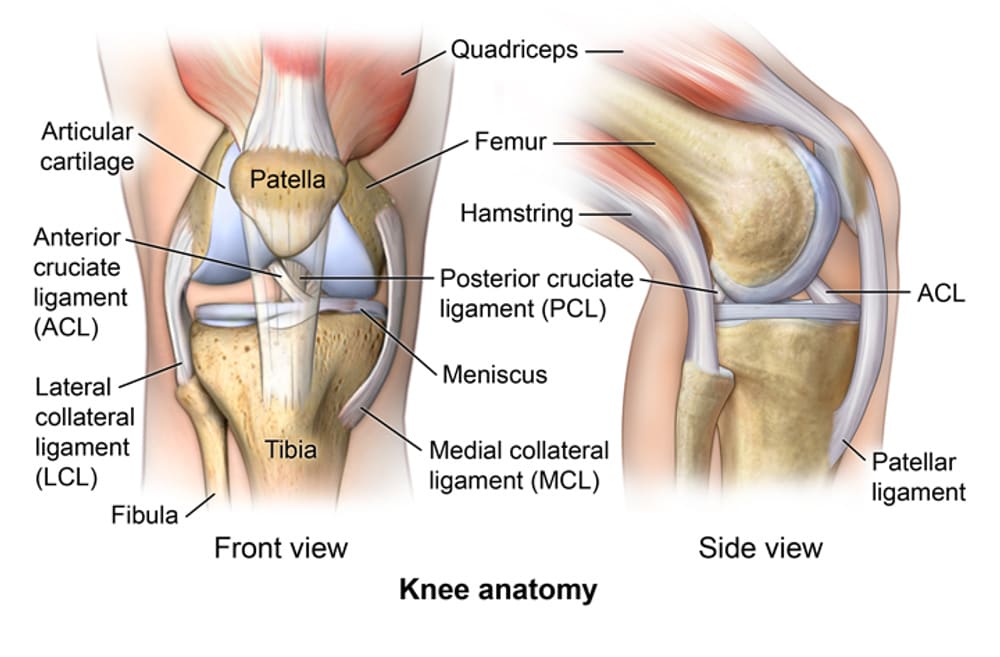
The knee operates essentially as a “hinge joint” much like a door hinge. The basic movement of the knee is approximately 5 degrees of extension (straightening) and about 135 degrees of flexion (bending). While the movement of the knee is fairly simple, the knee depends on the complex interplay of many small parts to function properly and without pain. Knees also serve to absorb high impact forces from our legs in activities such as running, jumping, skiing, etc. The quadriceps, hamstring, and calf muscles not only move the joint but also offer extra stability to the knee.
The knee is the joint connecting the femur (thigh bone) to the tibia (shin bone), with a bony knee cap overlying it known as the patella. Between the femur and tibia are two circular discs of cartilage known as the medial (inner) meniscus and lateral (outer) meniscus. Next, there are ligaments of the knee which are bands of connective tissue that hold bones or cartilage together. There are four major ligaments of the knee, two inside the knee joint and two on either side of the knee. Inside of the knee we have the anterior cruciate ligament (ACL – no relation to the concert) which crosses the posterior cruciate ligament (PCL). On the outside of the knee joint we have the lateral collateral ligament (LCL) on the outside and the medial collateral ligament (MCL) which is on the inner part of the knee. Finally, there are two tendons, which connect muscles to bones. The quadriceps tendon connects the quadriceps muscle to the patella (knee cap), and the patellar tendon which connects the patella to the tibia (shin bone).
Common knee injuries
Many acute knee injuries occur because of an unnatural motion of the joint, forcing it into a twisting motion, a hit from one side which pushes into a side-to-side plane, or chronically poor alignment due to muscle imbalances, poorly fitting or worn-out shoes, or consistently excessive body weight.
Most commonly, we tend to wear out the cartilage in the inside part of our knees first which put increased stress on the bones. This “wear and tear” is known as osteoarthritis and may be associated with pain climbing the stairs and intermittent swelling of the knee after vigorous activity.
One of the most serious and unfortunately most common knee injuries with skiers involves complete or partial tears of the ligaments within the knee. One of the most well-known tears is that of an ACL, which can also be associated with a tear of the MCL or medial meniscus. This can be associated with significant knee instability and pain.
Another common acute knee injury is tearing of the meniscus which can be associated with “clicking” or the knee getting “stuck”.
Knee injuries can also be associated with bone bruises in the femur, patella, or tibia, oftentimes referred to as contusions or bone marrow lesions, which can be quite painful.
“Traditional” Treatment Options
Successful knee pain treatment starts with a thorough evaluation of the structural support - the stabilizing structures and muscles that activate the knee joint. We call this anthropometric analysis, and it is a combination of physical examination and radiological (usually MRI) information.
Depending on the cause of your knee pain, there are a variety of treatment options available. First, evaluation and treatment by a skilled physical therapist can help identify abnormal movement patterns and can emphasize strengthening the muscles that stabilize and protect the knee joint such as the quadriceps, hamstrings and calf muscles.
If pain is the major complaint due to osteoarthritis of the knees, there are injections of steroid or hyaluronic acid available to help mitigate the pain and inflammation. While many physicians perform these “blind” in office without the use of imaging, we believe that these injections are better done with image guidance, to ensure that the medication arrives exactly where it needs to be.
“Regenerative” Treatment Options
If there is more significant derangement such as ligament, cartilage, or tendon tears, regenerative treatments may be a better option forward and may save you from “going under the knife”. These treatments focus on using your body’s own natural healing mechanisms to repair damaged tissues.
When the history, physical examination and imaging findings are appropriate for regenerative treatment of knee pain, the next important decision is what type of regenerative treatment is the best for each individual patient? In this respect, we at Precision Medicine offer a full range of therapies, from dextrose and ozone prolotherapy, platelet rich plasma (PrP), and bone marrow derived regenerative cells.
Prolotherapy involves the use of dextrose (sugar) injected to create an inflammatory response that will induce healing. PrP is an increasingly common treatment for knee pain and other injuries; it involves drawing your blood and spinning it to condense the healing factors. Bone marrow-derived regenerative cells are another treatment option, where we extract bone marrow from your pelvic bones and concentrate and isolate the regenerative cells.
For any regenerative treatment, we then inject the injured areas of the knee using image-guidance. We use a combination of ultrasound and fluoroscopic imaging for guidance. The extent and location of injuries will also guide our delivery into the knee. For example, if what we treat primarily is cartilage loss due to OA, we will have to deliver regenerative cells inside the bone articular surfaces, as well as inside the joints themselves, since cartilage grows from inside the bone and that’s where the cells will have their greatest efficacy. If what we treat primarily is a meniscus tear, we will deliver the cells precisely in the torn meniscus. In the days following the injections, there may be an increase in inflammation as your body’s healing response “kicks into overdrive”, which usually subsides in a few days.
Finally, our regenerative treatment is a comprehensive program that addresses several aspects of patient’s health (in conjunction with the actual injections of regenerative cells): working with a physical therapist to correct movement patterns and promote mobility and strengthening, the body’s nutritional status (as determined by our biomarker analysis) is optimized with the appropriate supplements, each patient’s ability to regenerate can be enhanced with hyperbaric oxygen treatments (we refer patients to ATX Hyperbarics), and each patient’s weight is normalized with our specialized weight loss programs.
We hope this article helps you understand various non-surgical treatment options for knee pain. As usual, if you have any questions, please call us for an appointment and we will answer them!